


For many ocean researchers and climate scientists, communicating climate risk can feel like screaming data and technical jargon into an echo chamber. When complex models and dire metrics are met with public apathy or doomism, the question becomes: how do we convey the urgency of the climate crisis without overwhelming, fearmongering, or paralyzing the people we need to reach?
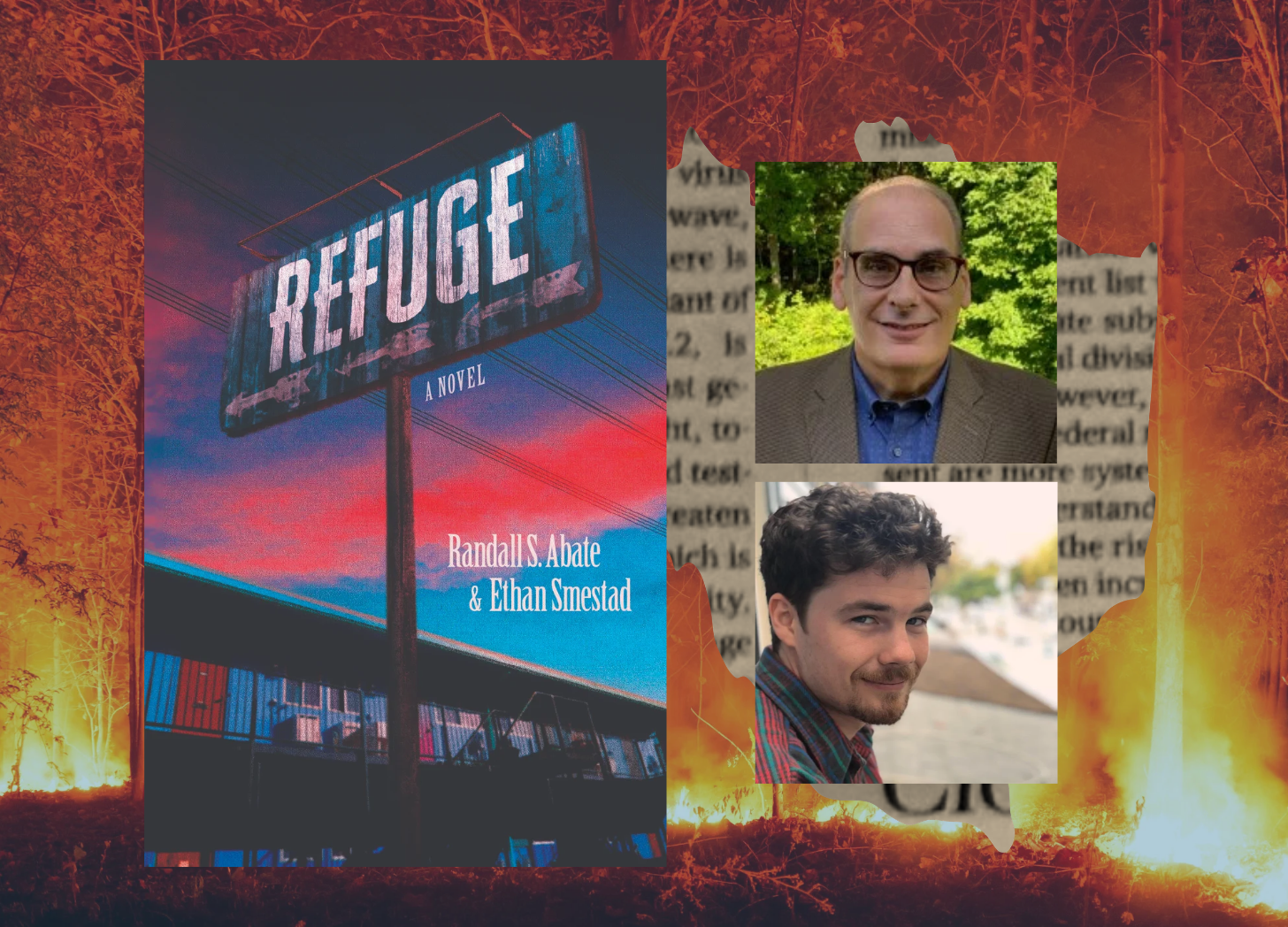
In this edition of The Confluence, I sat down with Randall Abate and Ethan Smestad, authors of the new climate fiction novel Refuge, to discuss how storytelling can turn complex facts into action by grounding today’s polarized political landscape and worsening climate realities in the personal journeys of its characters.
Abate, a visiting law professor at Florida State University College of Law and collaborating professor at Ocean Nexus, noted that fiction bridges the gap between facts and action where traditional legal writing falls short. “Storytelling informs and inspires readers in a way that lecturing and scholarly writing never could,” he said. “It makes the issues feel more personal, relatable, and actionable.”
Smestad, a writer, musician, and organizer based in New York, adds that instead of triggering fear, fiction also opens space for radical hope, agency, and creative-problem solving — and that tapping into human creativity can also be a form of survival.
“The best parts of culture come from this flourishing of human imagination and creativity. People are drawn to things that make them feel inspired in ways deeper than the shallow dopamine hits of social media,” he said. “I think climate activists and scientists would do well to be reaching out to the artists and creators of the world and building community.”
What makes Refuge so compelling, beyond the narrative, is how it was built. The novel stands as a practical case study in breaking down silos. Combining Abate’s legal expertise in climate mobility with Smestad’s creative writing, the authors grounded their process in clear boundaries, open communication, and a shared vision. Neither author could have written the book alone, showing how scholars and creators can join forces to make complex governance and scientific issues feel deeply human.
This conversation has been edited for length and clarity.
The Pacific Northwest is often viewed as “safe havens” when it comes to the climate crisis, even though as we’ve seen in recent years, wildfires and extreme heatwaves there have been quite devastating. In Refuge, Portland’s crumbling infrastructure, converted emergency shelters like the Refuge Inn, and local friction really reflect a harsher reality. Why was Portland the necessary backdrop for this story?
Abate: When I started working on an earlier version of Refuge in 2020, I selected Portland based on data at the time that indicated it was one of the top ten “climate-safe” cities in the nation. I wanted to base the story on a realistic dimension of how this displacement and resettlement crisis might unfold with waves of migration from climate-vulnerable cities to “climate havens” across the nation, which could most effectively accommodate climate-displaced populations no longer able to safely remain where they call home.
A cruelly ironic twist unfolded just a few years after starting this project, however, as many “climate-safe” cities like Portland, Oregon; Ashville, North Carolina; and Duluth, Minnesota were battered by climate-change exacerbated events like wildfires, heat domes, floods, and tornados with unprecedented frequency and magnitude.
Smestad: Part of the harsh reality is that people will move, regardless of whether supposedly climate haven cities are willing or prepared for these migrations. As a setting, it also felt ideal for me creatively: I have family in Eugene, Oregon and lived there for half a year. I hope my personal connection and affection for Oregon comes through in the writing!
The book starts with a young woman named Sierra and young Mateo, who is undocumented. Both just lost their parents in the same wildfire. Both recently orphaned. They get on this bus headed up north. Why did you decide to start with those two main characters?
Abate: My original vision was to focus on Sierra, a disillusioned, “broken” young woman with her whole life ahead of her yet with a very dim view of her climate-compromised future. She is haunted by the ghosts of her past trauma as she tries to move forward. Through Sierra’s experiences and perspectives in the story, I wanted to underscore the mental health impacts of the climate crisis on today’s youth. Ethan enhanced the spotlight on Sierra in a very compelling way with the addition of Teo as an engaging and lovable secondary character. Teo supports several sub-plots in the story but perhaps his most important role is a reliable vehicle for the reader to learn more about Sierra, who remains sullen and aloof as the story unfolds when she is among other characters in the story.
Smestad: When I became involved in the project, I felt strongly about not wanting to tell a story about climate activists. I wanted to focus on ordinary people who don’t think about the climate, until the climate suddenly and drastically shatters their lives. Home is something everyone connects to. I believed it was important to start the story with young people because what makes the climate crisis so existential for them is that it totally obfuscates their ability to imagine a future. The kind of future my generation was led to believe was possible for us is quickly disappearing. Sierra is at that age just entering adulthood where you’re in between everything: the innocence of childhood is over, but in an age of climate crisis, imagining a future for oneself to work towards is suspect in a totally different way. Whatever it is that’s ahead of us will be faced by the youth of the world, and they deserve to be centered.
The book also focuses heavily on marginalized experiences — from immigrant struggles to Indigenous sovereignty to queer experiences. How did you approach crafting these diverse perspectives authentically?
Abate: It was very important to us to tell these characters’ stories authentically. We recognized that two white men telling a story about diverse characters risked being perceived as patronizing and not authentic. We assembled a diverse range of test readers of earlier versions of the story and we received valuable feedback from readers who shared one or more pieces of the background of our characters. We also were careful to engage with Indigenous sensitivity readers in crafting Kosumi’s story. Telling the story with the necessary compassion also came naturally to both of us because we are committed in our professional and personal lives to uplifting the voices of underrepresented communities as reflected in my teaching and scholarship on climate justice and ocean equity and through Ethan’s political and social activism.
Smestad: Every human being responds to stories because they’re our oldest tool for empathy-training: We are constantly putting ourselves in the shoes of other people and imagining what it is like to be them. That imagining was greatly assisted by the feedback of Indigenous test-readers who could confirm that what’s imagined feels authentic and something they can see themselves in. It was very rewarding when our test readers told us they felt seen by what we portrayed.
One helpful suggestion by our Indigenous test-readers was to invent a tribe based on other tribes in the PNW region, rather than portray an actual tribe. We wanted to maintain the rigor of reality with what tribes in the PNW are dealing with in the face of climate change, but our readers cautioned that depicting a real tribe could get thorny very quickly. The beauty of fiction is that we’re still able to say something that is “true” without having to claim that it’s a “fact” — an important distinction.
In times of chaos and instability, there’s almost always a rise in far-right extremism, xenophobia, and eco-fascist rhetoric. In Refuge, as the displaced communities arriving in Portland try to adapt and create community, they face hostile locals and fascist actors. How did you approach writing about these extremist groups, and what warning does their presence in the story offer about a climate change-riddled future?
Abate: Life is stranger than fiction and that reality helped build these dimensions of the story. We are experiencing these threats in the US and around the world in palpable ways, so the story was able to build on those themes in a way that the reader can easily relate to and consider. The clash between nativism and fascism and socialism-like interventions by government will be on full display in the decades ahead as society tries to fashion an effective response to the climate mobility crisis in a way that prevailing political and social values can tolerate.
Smestad: The empathy of fiction writing extends to everyone. John Keats called this “negative capability,” which is the need for a writer to inhabit and imagine the inner world, experience, and perspective of people that you might totally be disgusted by. While there were clearly people in the story who were antagonistic to the Refuge residents, I hoped to make clear that they also possess a perspective and line of reasoning; they’re people who feel like others are trying to take their home away from them and they have to fight to hold onto it; it’s a very old story in the history of humanity, one that’s still going on. At various points, the heroes and villains shift and change. Our tech billionaire stand-in, Jerry Bucknell, might earnestly believe he’s doing what only he can do to save the world from ecological crisis, even as it’s also true the climate crisis has empowered him with undue agency over the fate of humanity. Ultimately, the main question of the book is: in the face of it all, will we turn against each other, or will we set aside our differences, work together, and dare to care about each other?
It was very important to us to tell these characters’ stories authentically. We recognized that two white men telling a story about diverse characters risked being perceived as patronizing and not authentic. We assembled a diverse range of test readers of earlier versions of the story and we received valuable feedback. - Abate
One of the most unnerving parts of this novel is how even as communities are being displaced and government agencies struggle to manage basic needs, corporate figures and private developers always find a way to profit from tragedy. Why was it important to show that capitalism doesn’t just pause during a climate emergency? How does it reflect today’s current events?
Abate: We have to work with the tools that we have and the limitations of our political and cultural realities as best we can in responding to climate displacement and resettlement. Capitalism is a driving force behind why we are suffering from widespread climate impacts, but it also can be part of effective responses to the problem. Public-private partnerships in responding to the crisis may be the only way we can effectively address the challenges at scale. We may have to set aside our concerns about the imperfections in that approach. The government lacks the resources and the private sector lacks the political will to address climate mobility challenges independently of the other.
Smestad: I like to think that this kind of fiction is also a form of rhetorical argument. In imaginative fiction, we have the ability to propose alternatives and demonstrate how things might be other than they are — but in order for it to be persuasive, we must start with acknowledging the reality of things as they currently are. It was important to start in the world we actually have, and look at how we might creatively use the tools at hand. For us to meet the scale of the crisis, private-public partnerships may not be ideal, but they’re the most expedient, especially as the climate crisis becomes exponentially critical and urgent. In dealing with eco-anxiety, one of my personal silver linings is precisely all the unknowns: black swan events happen, unpredicted anomalies that shift what we believed were certainties, and situations might emerge that completely alter our forecast.
There is a lot of loss in this book. What do you hope readers take away about climate grief, and how fiction can help process real-world eco-anxiety?
Abate: One of the most important messages of the book is the power of human resilience and how we are strongest when we work together in the face of adversity. Climate change isn’t the first existential threat to humanity, and it won’t be the last. But climate-related stress and grief from climate-related losses will only get worse as this century progresses. Refuge offers a way to embrace that reality in a hopeful way. Through the losses and grief, we must find ways to persist, cooperate, and recognize our shared vulnerability in the face of climate-related threats as a bond that unites us despite our differences.
Smestad: Part of what I brought to this story is my own experience of grief: I lost both my parents to cancer within five years of each other by the time I was 23. Despite all of the pain, one thing I learned without a doubt is that most of the joy, happiness and meaning in our lives comes from our relationships, our community, and the people we love. It makes grief a beautiful thing to me, because the pain is an expression of all that we love. Grief can destroy us, and it can send us into isolation — this is Sierra’s struggle: once you know that anything or anyone you care about is something that you will one day inevitably lose, it can feel impossible to still love and care and agree to take on that pain. If we can be brave enough — in community, we can — then we might find that grief and loss makes us more human and put us in touch with that loss that’s common to everyone. It might dissolve the parts of ourselves that are petty and self-involved, and open us up to that un-selfish caring that not is the only way we’ll survive, but the only reason surviving is even worth it.
Click here to order Refuge both available on E-book and hardcover copies.

Feeling like reading some more?
One thing that didn’t make the Q&A above was Ethan’s recommendation to read the work of Tractor Beam, a quarterly speculative and science fiction literary magazine dedicated to soil punk — a genre focused on radical, hopeful, and anti-apocalyptic futures rooted in the Earth, farming, soil science, and regenerative agriculture.
Their recent issue focused specifically on themes about the ocean and marine science — scroll down and read stories about coral reefs, the sea floor, floods, and more.