


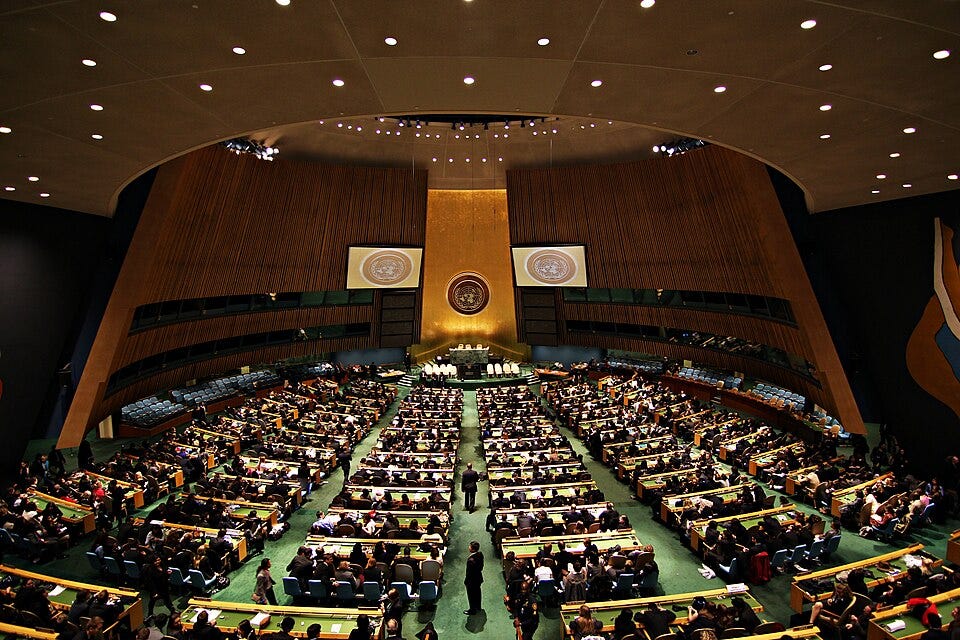
At the United Nations General Assembly last Thursday, world leaders unanimously adopted a first-ever declaration affirming that nations losing land to sea level rise will maintain their statehood, international standing, and maritime rights. The landmark resolution comes as rising seas threaten 770 million people—or roughly 1 in 10 humans—who live in coastal areas worldwide, according to a recent report by the UN.
Spearheaded by small island states facing compound threats from climate change and a strengthening monster El Niño, the agreement ensures that vulnerable nations will not lose their political existence even if their physical land vanishes. Historically, international law tied statehood directly to physical territory, leaving nations like Kiribati, Tuvalu, and the Marshall Islands to face a terrifying prospect that losing land could mean losing UN recognition, citizenship rights, and sovereign control over their oceans—a void the resolution aims to close.
The declaration also locks in place maritime boundaries established under the UN Convention on the Law of the Sea (UNCLOS), ensuring nations retain exclusive rights to fishing, energy development, and ocean resources, even as coastlines erode.
“For Tuvalu, sea level rise is not a future threat; it is a present reality,” Tuvalu Prime Minister Feleti Teo told the UN General Assembly last week. In 2022, his country already announced plans to become the world’s first “digital nation,” which aims to move all government functions like holding elections, registering births and death certificates into a digital space.
The declaration “affirms that Tuvalu’s nationhood is not negotiable, that our maritime rights are not erasable, and that our people should never be forced to choose between their homeland and their future,” Prime Minister Teo added.
While non-binding, the resolution enshrines a “presumption in favor of continued statehood”—a concept that directly aligns with last year’s landmark climate ruling by the International Court of Justice (ICJ). Championed by the island nation of Vanuatu, the historic ICJ advisory opinion established that under international law, major polluters bear legal duties to cut emissions and compensate for climate harm, while affirming that “once a State is established, the disappearance of one of its constituent elements would not necessarily entail the loss of its statehood.”
One of the most notable aspects of the day-long debate was how the agreement moved forward with no objection. The United States, in particular, which has withdrawn from the Paris Agreement and moved to slash federal ocean research, did not take the floor nor block the text.
Historically, the US has often acted as a powerful spoiler or diluting force when small island states and other climate-vulnerable nations have pushed for progressive UN declarations, binding climate treaties, and international ocean frameworks. (The US has not ratified UNCLOS, for instance). To protect domestic industrial interests and avoid legal liabilities, the US has routinely blocked or weakened language establishing historical responsibility for climate change, liability for loss and damage, mandatory emission reduction targets, and strict regulation of deep-sea mining. Coalitions like the Alliance of Small Island States (AOSIS) have frequently had to navigate or challenge US resistance.
The reason for US cooperation, experts say, could be purely economic. Coastal cities like New York and Miami are economic hubs that boast millions of jobs and drive global trade, yet data shows that global assets valued between $2 trillion and $3.5 trillion face flooding.
“Sea level rise is measured in millimeters, but the toll is measured in millions of shattered lives, uprooted communities, and stolen futures,” said UN Secretary-General António Guterres. “We cannot allow countries and cultures to be lost beneath the waves.”
The declaration also comes as a new report released Wednesday by more than 100 international scientists warns that oceans are warming at an “alarming pace,” unleashing impacts for which the world is ill-prepared. Global oceans now trap nearly 90% of the excess heat generated by humans burning fossil fuels that the rate of ocean warming has doubled over the last two decades, driving record-breaking sea surface temperatures in recent years.
While historic, environmental advocates say the agreement stops short of forcing major polluters to pay for the devastation they’ve wrought. That shortfall looms large as the planet teeters on the brink of overshooting 1.5 degrees Celsius—the scientific guardrail established to prevent irreversible climate breakdown.
“The Declaration cannot stop the sea from rising. Only climate action can do that,” Republic of Palau President Surangel Whipps Jr., who is also the chair of AOSIS, said in a statement last Thursday. “We will press major emitters for deep and rapid emission cuts consistent with 1.5°C, and for adaptation finance that reaches our islands.
The legal protections affirmed today and ambitious climate action must advance together,” he added.

On my reading list
South Korea’s Quiet Pursuit of the Deep Sea, Dunia
US Virgin Islands Bets on More Cruise Tourism as Residents Call for Economic Diversification, Centro de Periodismo Investigativo
The Pesticide Papers: Guam Residents Feared the Military Was Poisoning Them. New Records Reveal Decades of Toxic Contamination. The Margin and The War Horse
Plastic fused to coral rubble raises new concerns for ocean pollution, Mongabay
She governs a US territory. But she has no say in who mines its waters. Grist