


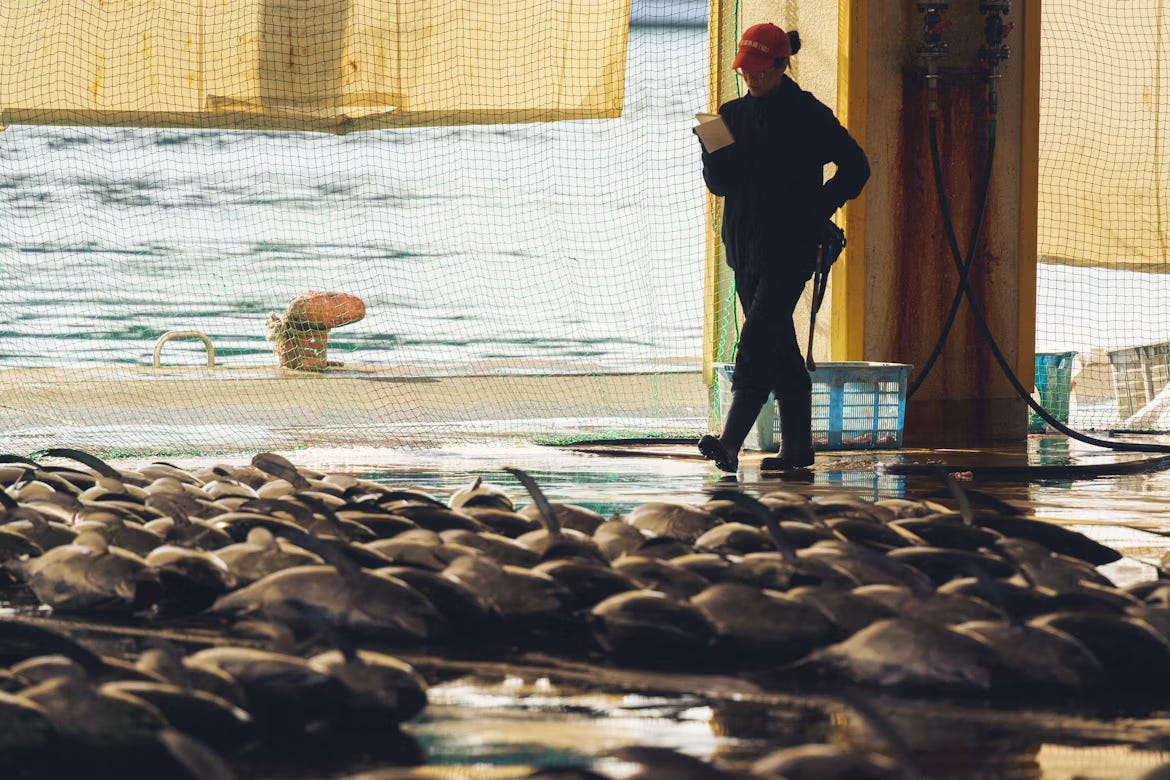
Imagine being a fisherman in the village of Ine, a scenic coastal village in the Kyoto Prefecture famous for its traditional funaya boathouses. You wake up early in the morning to start your daily catch. But as you pull your fixed coastal nets from the waters, you see something that would have felt like a winning lottery just a few years ago: a bounty of Pacific bluefin tuna filling your net.
First, you feel excitement. But then, you remember that under Japan’s strict national quota system, if you kept your haul, you would instantly blow through your entire season’s catch limit before summer even peaked. That means you would have zero quota left for the late autumn and winter months, when the Pacific bluefin tuna grow fattier, tastier, and fetch top-tier prices at market.
So you do the unthinkable: open the nets and release possibly millions of yen worth of prized fish back into the ocean. But as the giant tuna surged out, they took with them the mackerel, squid, and other fish you were legally allowed to keep.
This is the reality for most fishermen in Japan. “Not being able to keep all the fish you could potentially have caught is just part of effective fisheries management,” Andre Boustany, principal investigator of global ocean conservation at the Monterey Bay Aquarium, told The Confluence .
“The core of fisheries management is putting limits on catch,” he added. “ In the past, there were no limits on catches of Pacific bluefin tuna, which led to the stock being in horrible shape.”
But the Pacific bluefin tuna have staged a remarkable comeback in recent years, surging from a low of roughly 2 percent of unfished levels around 2010 to over 23 percent by 2022. Many largely attribute the sudden recovery to strict international protection and conservation measures, but some experts believe climate change-fueled shifts in migratory patterns play a role.
Pacific bluefin tuna are highly migratory species. And much like other fish and marine animals, they are likely shifting migration patterns due to warmer ocean water. A 2022 study by Rutgers University researchers found that large species and commercially important fisheries will shift out of their historical ranges and will likely be less abundant in their new geographic ranges as the climate warms.
“What that suggests from a fisheries perspective is that while the species we fish today will be there tomorrow, they will not be there in the same abundance … overfishing becomes easier because the population growth rates are low,” Malin Pinsky, an ecologist and co-author of the study, said in a statement at the time.
“Warming coupled with food-web dynamics will be like putting marine biodiversity in a blender,” Pinsky added.
With the Pacific bluefin tuna’s spawning numbers reaching more than 23 percent, crossing the sustainable yield threshold a decade ahead of the initial 2034 target, the international bodies governing North Pacific fisheries are looking to reward countries with cautious quota increases while also ensuring strict long-term guardrails stay in place to prevent another collapse.
That balance was central to discussions when international delegates met in Nagasaki this July. Japan, the world’s largest consumer of bluefin tuna, has repeatedly submitted formal proposals requesting an increase to commercial quotas. The country argued that Japanese fishermen face a dilemma of releasing bluefin tuna that would frequently flood into coastal set-nets intended for other species, often causing other target fish to escape or damaging gear, resulting in major financial losses.
But because decision-making among the key regional fisheries management organizations — Western and Central Pacific Fisheries Commission (WCPFC) and the Inter-American Tropical Tuna Commission (IATTC) — require a unanimous consensus, negotiations to adopt a harvest strategy reached a stalemate. Several nations pushed for a larger share of the total catch, while others resisted, arguing that rapid quota increases could derail the fishery’s long-term 20-year recovery plan.
Still, the final agreements were shadowed by significant ecological uncertainties surrounding the climate crisis. Scientists warn that warming waters and shifting ocean currents could destabilize future recovery by disrupting delicate spawning cycles, juvenile survival rates, and historical migration routes across the Pacific.
As climate change drives fish populations into new territories, Boustany said it is also forcing a overhaul of traditional diplomatic rules. Because historical quotas reflect where fish used to live, host nations now find themselves surrounded by abundant stocks they are not allowed to harvest, prompting calls to renegotiate catch allocations based on where the fish are actually located today.
“In the case of Pacific bluefin, due to stock recovery, there are more bluefin in everyone’s waters,” Boustany said. “So the ask to change the country allocations is not due to climate change per se, but rather driven by countries wanting more quota for their fisheries.”
Boustany also attributes the bluefin's remarkably rapid rebound primarily to strict international management, paired with the species' fast-recovering biology and a recent string of warm, highly productive spawning years. While conservative scientific modeling initially set low expectations, recent warmer waters may have boosted young fish survival rates, he said. However, like many experts, he cautioned against relying on warm ocean water for future growth, noting that climate change represents unpredictable wild cards for migration and ocean ecosystem overall.
“Climate change-induced shifts in migration patterns of Pacific bluefin are less well studied than in other species, but it is safe to say that climate change is impacting distributions and many other life history traits of pretty much all fish species,” Boustany said. “I think the main point to make with the recovery to date is that these fish can recover solidly if given a chance.”

Figure of the week: 92
The percentage of tested deep-sea animals containing microplastics, affecting 11 of 12 specimens researchers sampled across four species of mussels and snails. | Source: Mongabay

A castaway read 🏝️
By Natasha Vizcarra
On the morning of July 11, 2023, marine wildlife veterinarian Dr. Joe Gaydos stood in front of a beautiful, six-foot-long fish that had washed up on Crescent Beach, Orcas Island. Its body was torpedo-shaped, and its skin was gun-metal gray with an iridescent sheen. Gawkers thought it looked like a tuna of some sort. In fact, someone had already carved a huge fillet out of it.
But it wasn’t in the book Gaydos brought with him, “A Field Guide to Fishes of the Salish Sea,” a newly published guide to the inland sea around Puget Sound, the San Juan Islands, and the waters off Vancouver, British Columbia. “When I saw that it was not in the book, I knew that it was something big,” Gaydos said in a podcast three months later.
The fish, later identified as a Pacific bluefin tuna, had never been documented in the Salish Sea until that morning. As an oceanic pelagic fish, meaning a migratory fish of the open ocean, bluefin tuna has an impressive range that spans the sea around Japan to the waters off California and Mexico. It’s just not the kind of fish that would seek narrow, inland waters like the Salish Sea.
Read the full story here at University of Hawai’i’s Sea Grant page.