


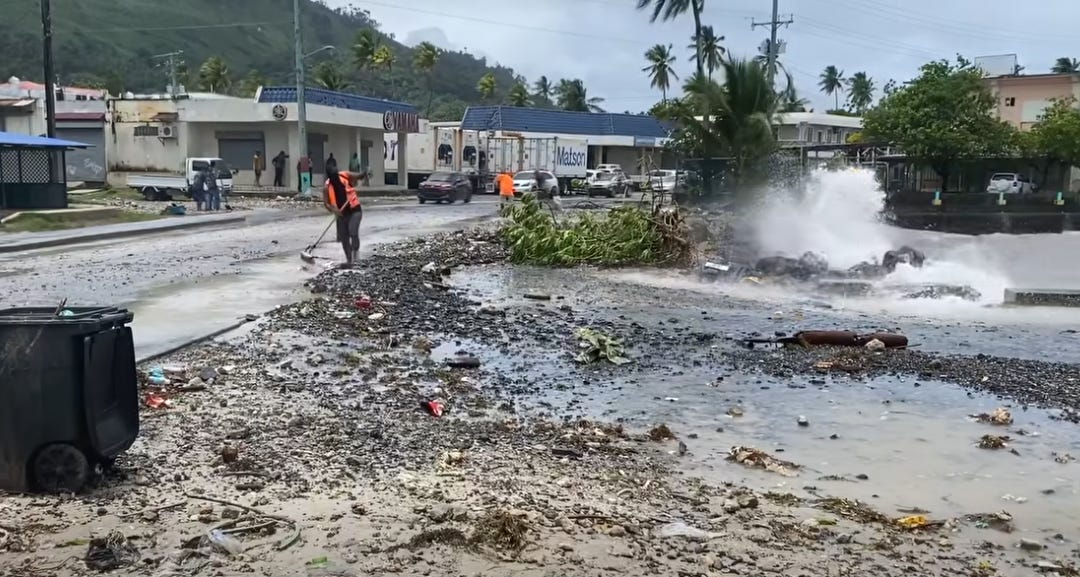
In April, the world witnessed the terrifying fury of the most powerful tropical cyclone recorded globally in 2026. Super Typhoon Sinlaku exploded into the second strongest Pacific typhoon ever observed so early in the year, carving a path of unprecedented ruin through Micronesia.
But before it barreled north to ultimately wreak havoc on the U.S. territory of the Northern Mariana Islands — stalling offshore for hours and grinding the islands of Saipan and Tinian beneath its monstrous eyewall — Sinlaku delivered its first catastrophic blow on another Pacific island: Chuuk.
Chuuk is an island state within the Federated States of Micronesia (FSM), a sovereign nation in the Pacific Ocean with a special agreement with the United States called the Compact of Free Association (COFA). Under COFA, the country relies on the U.S. for financial assistance as well as defense and security. In exchange, the U.S. holds strategic military access across Micronesia.
Disaster relief in the FSM operates under a completely different framework than in U.S. states or U.S. territories like the Northern Mariana Islands or Puerto Rico. Under COFA, FSM’s government must formally request American aid on behalf of affected states like Chuuk. Once requested, the U.S. Federal Emergency Management Agency (FEMA) deploys alongside the State Department’s newly formed Bureau of Disaster and Humanitarian Response — which absorbed these international relief duties following the dissolution of USAID — blending American emergency resources with FSM’s own local revenue streams to fund the recovery.
But Chuuk’s geography is uniquely challenging: its population is scattered across 40 separately inhabited islands, each operating as its own distinct municipality. Spanning thousands of square miles of open ocean, simply transporting aid, construction materials, and personnel between these isolated communities makes the current recovery an exceptionally costly and complex race against time.
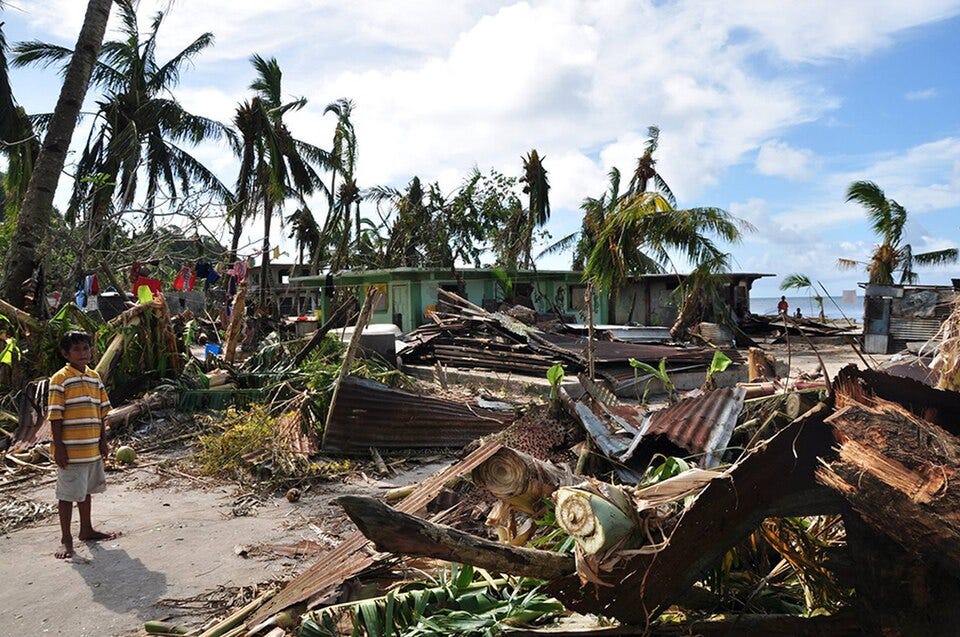
Chuuk was already deeply vulnerable before Super Typhoon Sinlaku struck. The last major storm to hit the island was 2015’s Typhoon Maysak, destroying thousands of homes and marking the island’s worst extreme weather disaster in over twenty years. And because that recovery was so painfully slow, many displaced residents were ultimately forced to leave the island entirely, migrating to Guam, Hawai’i, or the continental U.S.
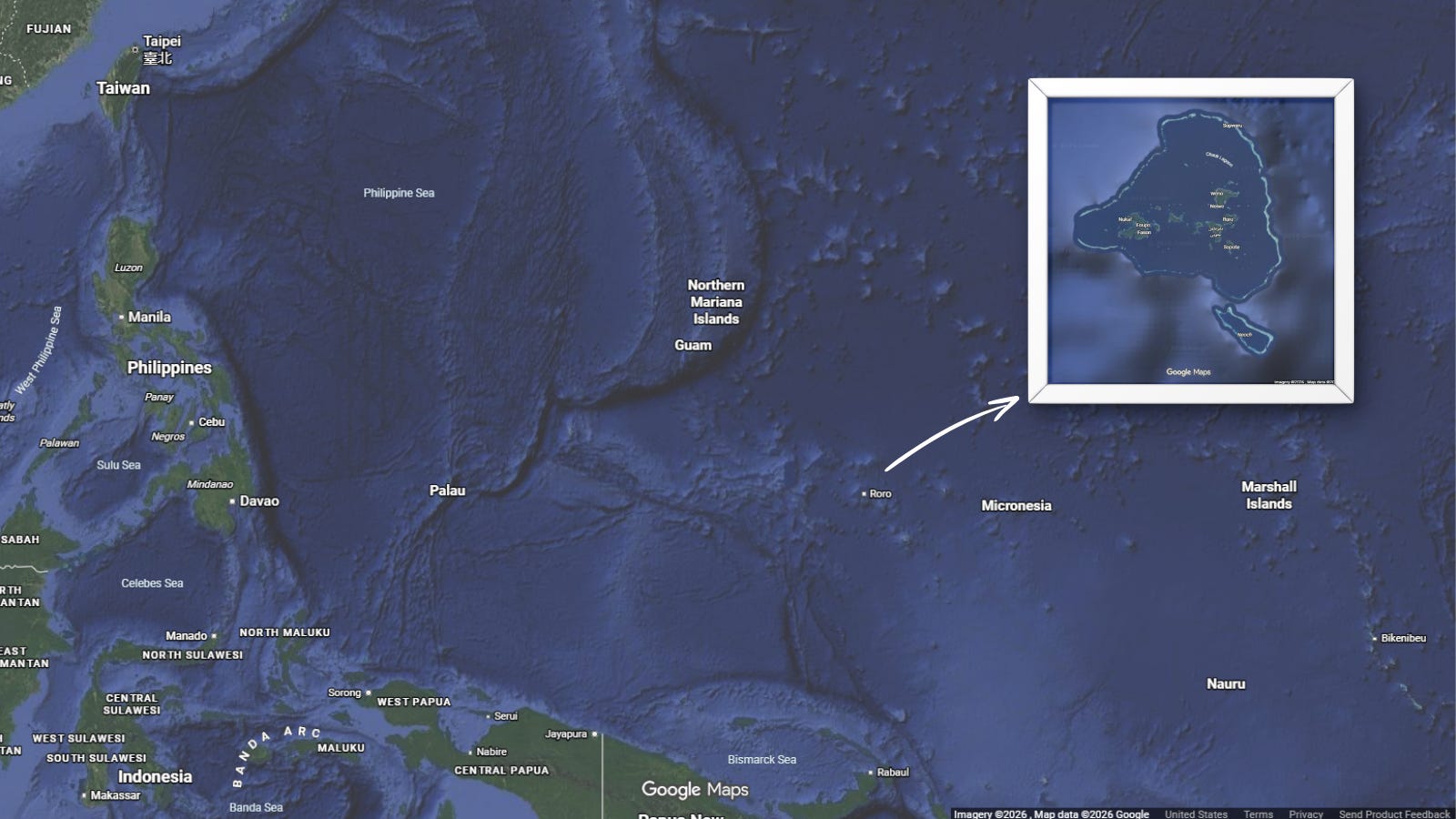
It’s been over a month since Sinlaku hit, and thousands of people across Chuuk and the Northern Mariana Islands still have no power or access to running water, largely relying on mutual aid efforts. The latest death toll has risen to 17 across the region, mostly on the island of Chuuk.
“Many people are still very much impacted by the loss,” Joe-Silem Enlet, a doctoral candidate in marine affairs at the University of Rhode Island and research fellow with Ocean Nexus, told The Confluence. “Everyone is connected in some way, so grief moves through the whole community, not just individual families.”
I recently caught up with Enlet, who is also a political consultant and advisor to the Weno municipality, the storm’s hardest hit area in Chuuk, a month after Super Typhoon Sinlaku ravaged both our home islands.
This interview has been slightly edited for length and clarity.
Rachel: First off, how has it been since Typhoon Sinlaku pummeled Chuuk? I’ve been hyper-focused on what the storm did to my hometown in the Northern Marianas, but I’ve seen the death toll rise in your home island. How are you doing? How has it been?
Joe: It’s been difficult, to be honest. Typhoon Sinlaku has disrupted many lives for sure. The immediate damage left homes damaged, infrastructure impacted, communities cut off, but what lingers is the slower, heavier reality of recovery.
For me personally, it’s been a mix of concern, frustration, and responsibility — concern for family and community on the ground, frustration at how limited and slow support can sometimes feel, and a deep sense that we have to show up for each other in whatever ways we can, locally and across our islands. At the same time, there’s also resilience. People are sharing what they have, rebuilding together, checking in on one another. That’s something storms don’t take away.
I’ve been following what happened in the Northern Marianas too, and am really sorry to hear about your hometown. These storms remind us how connected our experiences are across the Pacific, even when we’re each dealing with our own immediate crises.
Rachel: Thank you so much. It’s hard to talk about policy or long-term adaptation when people are still clearing debris and helping neighbors, but what are your thoughts on post-disaster recovery and adaptation in our home islands as the climate crisis intensifies more storms like it did Typhoon Sinlaku? What do you think needs to happen?
Joe: That’s a really important question, and honestly, something we need to be talking about more seriously.
I think one of the biggest issues with post-disaster recovery in our islands is that it’s still too reactive. A storm like Typhoon Sinlaku hits, and then we scramble. Aid comes in, assessments get done, things get patched up, but we’re not always building back in a way that actually prepares us for the next one.
What needs to happen is a shift from short-term recovery to long-term resilience. That means stronger infrastructure, but also investing in local systems: food security, water systems, community-based response networks. The things that actually sustain people when outside help is delayed.
I also think what’s missing is trust in local knowledge and leadership. Too often, recovery plans are driven by outside frameworks that don’t fully understand how our communities function. But our people already know how to adapt, we’ve been doing it for generations. That knowledge needs to be centered more.
Rachel: The Northern Marianas is a U.S. territory, but Chuuk is part of the Compact of Free Association (COFA) agreement with the U.S., which many people don’t really know the meaning of. What are your thoughts on Chuuk’s relationship with the U.S. in terms of disaster recovery?
Joe: That’s a great question, because a lot of people hear “COFA” but don’t really know what it means in practice.
Here’s the key part: the funding [from the U.S.] doesn’t always flow as directly or as quickly as people might expect. Because FSM is not a U.S. state or territory, there are additional layers, coordination between national and state governments, approvals, and sometimes limitations on what programs apply. That can slow things down.
A lot of disaster relief also depends on pre-existing agreements, available funding under COFA, and how well systems are set up to receive and distribute aid. That’s why you sometimes see gaps between when a disaster hits and when meaningful assistance reaches communities.
At the same time, local governments and communities play a huge role. In many cases, immediate response and early recovery are carried by families, municipalities, churches, and local networks long before outside assistance fully arrives.
So COFA creates a relationship where support is there, but it’s not the same as being fully inside the U.S. system. That difference really shows during disasters.
Rachel: This brings us to a conversation about sovereignty. Chuuk is not a sovereign nation itself but a state within the Federated States of Micronesia. With the rising intensity of storms, many argue that current disaster relief is a form of “climate colonialism.” What specific policy shifts do you think would allow small island states like Chuuk to move from surviving the next storm to thriving in a way that doesn’t rely on a constant influx of external aid? Is it even possible?
Joe: That’s a hard question, but it’s the right one.
I do think there’s truth in the idea of “climate colonialism,” especially when recovery keeps us dependent where we’re waiting on outside timelines, priorities, and even definitions of what resilience even looks like. For a place like Chuuk, within the Federated States of Micronesia under the Compact of Free Association, that dependency can get built into the system.
But I also think it is possible to move toward something different, though it won’t be quick, and it won’t be purely internal either. Some things need to shift for sure. We have to invest in local capacity as the foundation, not as an afterthought. That means directing funding, whether from COFA, climate finance, or development partners, straight into state and municipal systems, and even community-level institutions, so they can actually plan, implement, and respond on their own terms. Right now, too much capacity sits outside, in consultants and external agencies.
Food and water sovereignty has to be treated as disaster policy, not just development. If communities can reliably feed themselves and access clean water after a storm, that alone reduces dependency dramatically. Those can help create a resilient system.
Infrastructure needs to be rethought for our context and not just imported from the outside. We keep rebuilding the same vulnerable systems. What would it look like to design housing, energy, and transport around storm realities and local materials, informed by Indigenous knowledge and practices that already understood these environments?
Is full independence from external aid realistic? Probably not in the near term. These are small island economies facing global-scale climate impacts. But reducing chronic dependency, that’s absolutely possible. Besides, each island community in Chuuk and across Micronesia have been resilient and able to survive for thousands of years on their own.
Nevertheless, the goal isn’t to cut off relationships. It’s to rebalance them, so support strengthens local systems instead of replacing them.
Rachel: To ensure that the people of the Marianas and Chuuk aren’t perpetually forced into this state of emergency, how do we hold space for both the urgent needs of today and the long-term structural changes — like ocean sovereignty or local grids — that would finally break this cycle of constant rebuilding?
Joe: That tension is real and I think a lot of our communities are living in it right now.
When a storm hits, the priority is immediate: clearing debris, checking on family, getting water and food, just making sure people are okay. But at the same time, if we only stay in that emergency mode, we can end up repeating the same cycle every year. So it shouldn’t be one or the other but how we intentionally link the two.
One way is making sure that recovery dollars, whether through national systems, COFA support, or partners, aren’t just used to restore what was lost, but to quietly build toward something different. For example, if you’re rebuilding homes, can they be designed for stronger storms? If you’re restoring water systems, can they be more decentralized and managed by the community?
Another part is who is doing the planning? Communities themselves don’t always have the space to think long-term when they’re in crisis. That’s where governments, local leaders, and institutions need to step in, not to impose solutions, but to hold that longer vision on behalf of the people, while still staying grounded in what communities actually want.
I also think we need to treat things like ocean sovereignty and local energy systems (like community-based grids) not as abstract policy goals, but as disaster response strategies. Because they are. The more control you have over your food, your water, your energy, your ocean space, the less dependent you are when the next storm hits.
Rachel: Pacific islanders are on the front lines of storms they didn’t cause. What does a just recovery look like? How do we support “ocean equity” so that Indigenous knowledge isn’t lost or replaced by outside technology during the recovery?
Joe: Pacific Islanders are dealing with impacts we didn’t create, and yet we’re often expected to adapt on terms that aren’t our own.
In terms of ocean governance, a just recovery shouldn’t just be about rebuilding infrastructure or restoring fisheries, but about restoring relationships. Relationships between people and ocean, between communities, and even between knowledge systems. Too often, recovery efforts treat the ocean as a resource to be managed, rather than a living system we are part of.
“Ocean equity,” to me, means that the people who are most connected to and dependent on the ocean, like our fishers, our coastal communities, our knowledge holders, are the ones shaping how recovery happens. One of the biggest risks after disasters is that outside solutions come in fast with new technologies, new management systems, new data-driven approaches, and they can unintentionally displace Indigenous knowledge. Not because that knowledge isn’t effective, but because it isn’t always recognized as “legitimate” in those systems.
So supporting ocean equity means a few key things like protecting and prioritizing Indigenous knowledge as governance, not just culture. That means recognizing traditional fishing practices, seasonal knowledge, and reef stewardship as valid forms of management, and not something to be replaced by external science, but something that science should work alongside.
My concern is always ensuring that communities have real authority over their marine spaces and how they manage those spaces. I think it is also very crucial to invest in the next generation of knowledge holders. If young people are disconnected from fishing practices, language, and ocean relationships, then recovery, even if it looks successful on paper, is actually a loss.
Thank you so much for this piece and thank you Joe to talk about various concerns as well as updated information. In US we dont hear enough about this urgent issues. When Japan had a large tsunami 2011, external concern was more about the long term rather than immediate and it was because the community knowledge was not respected and prioritized. This is what needs to be changed .Joe, I hope you stay close to your communities and family.