


This story is part of Betting the House, a pop-up climate newsroom bringing together independent journalists to cover climate and housing. Learn more, and read other stories from the project here.
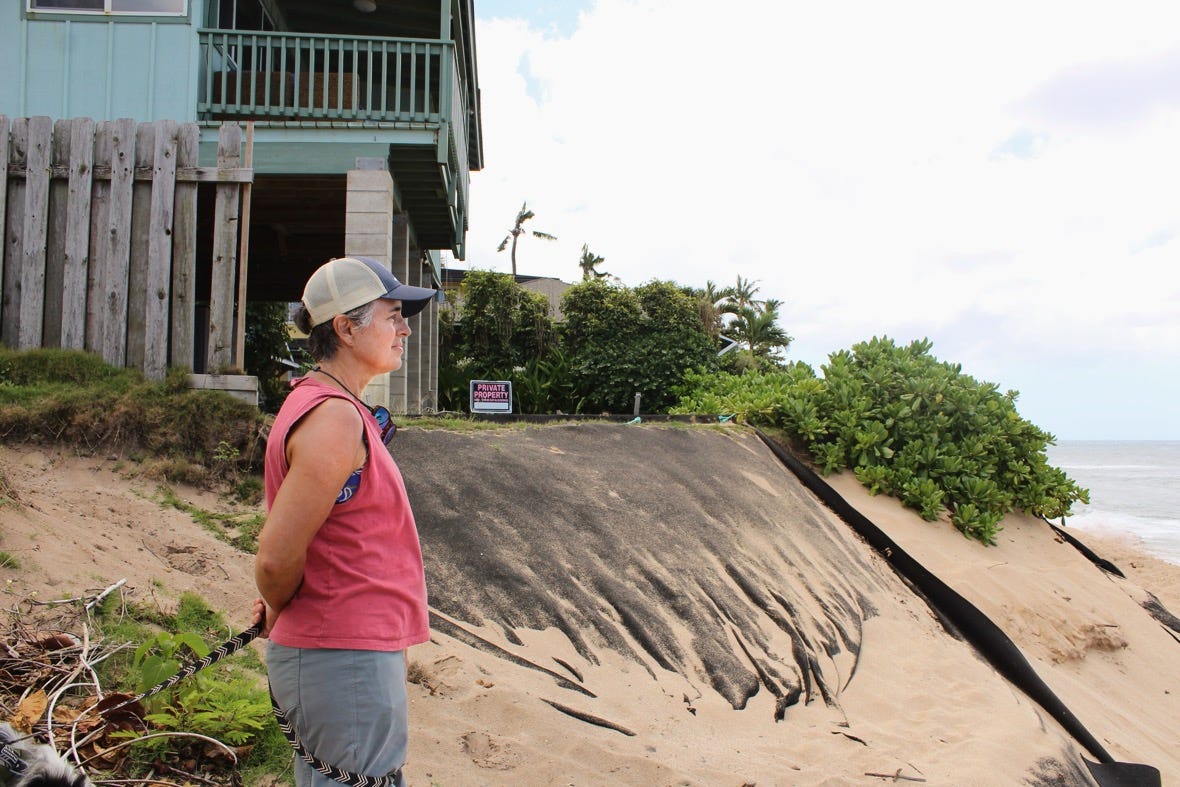
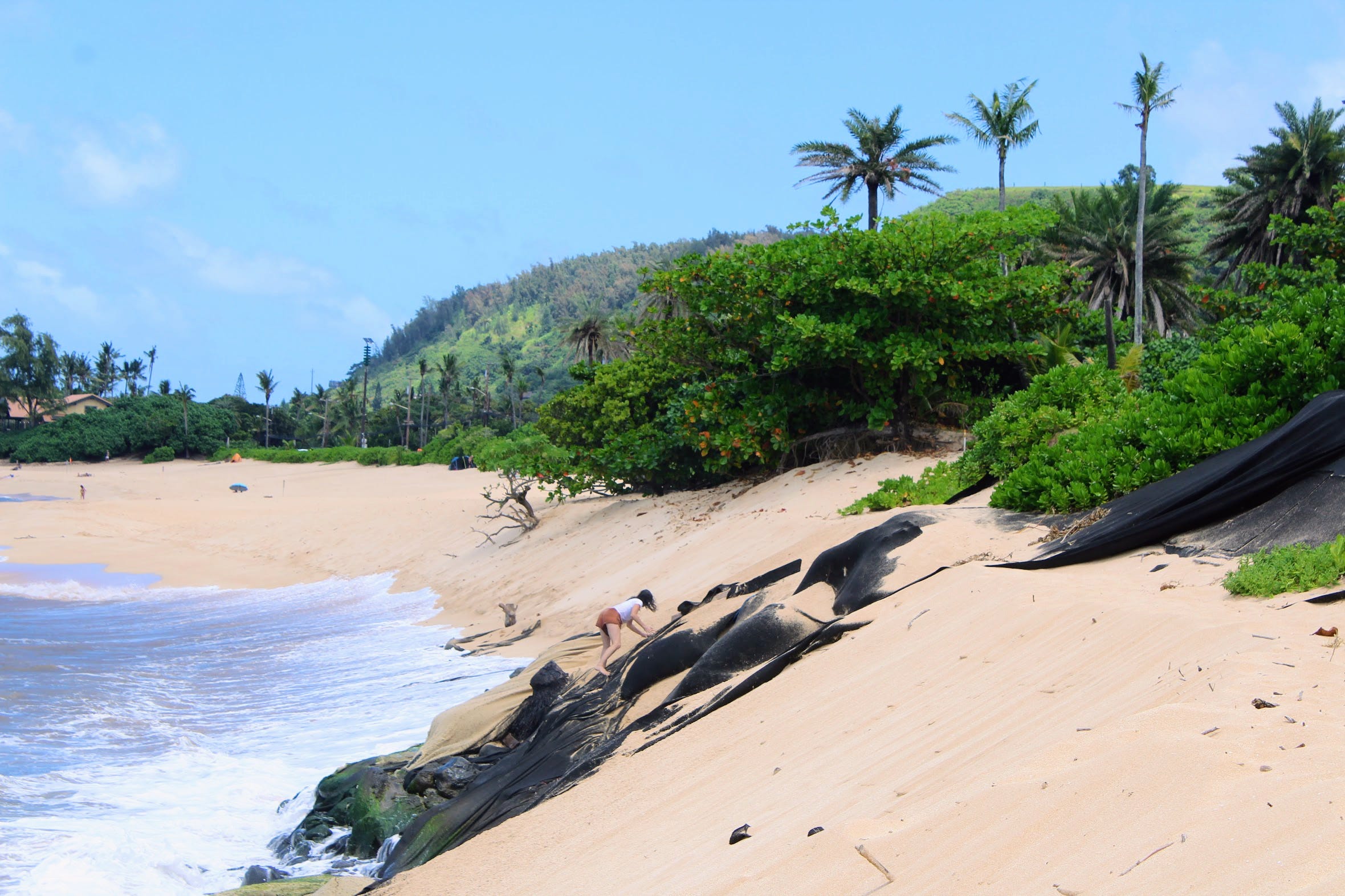
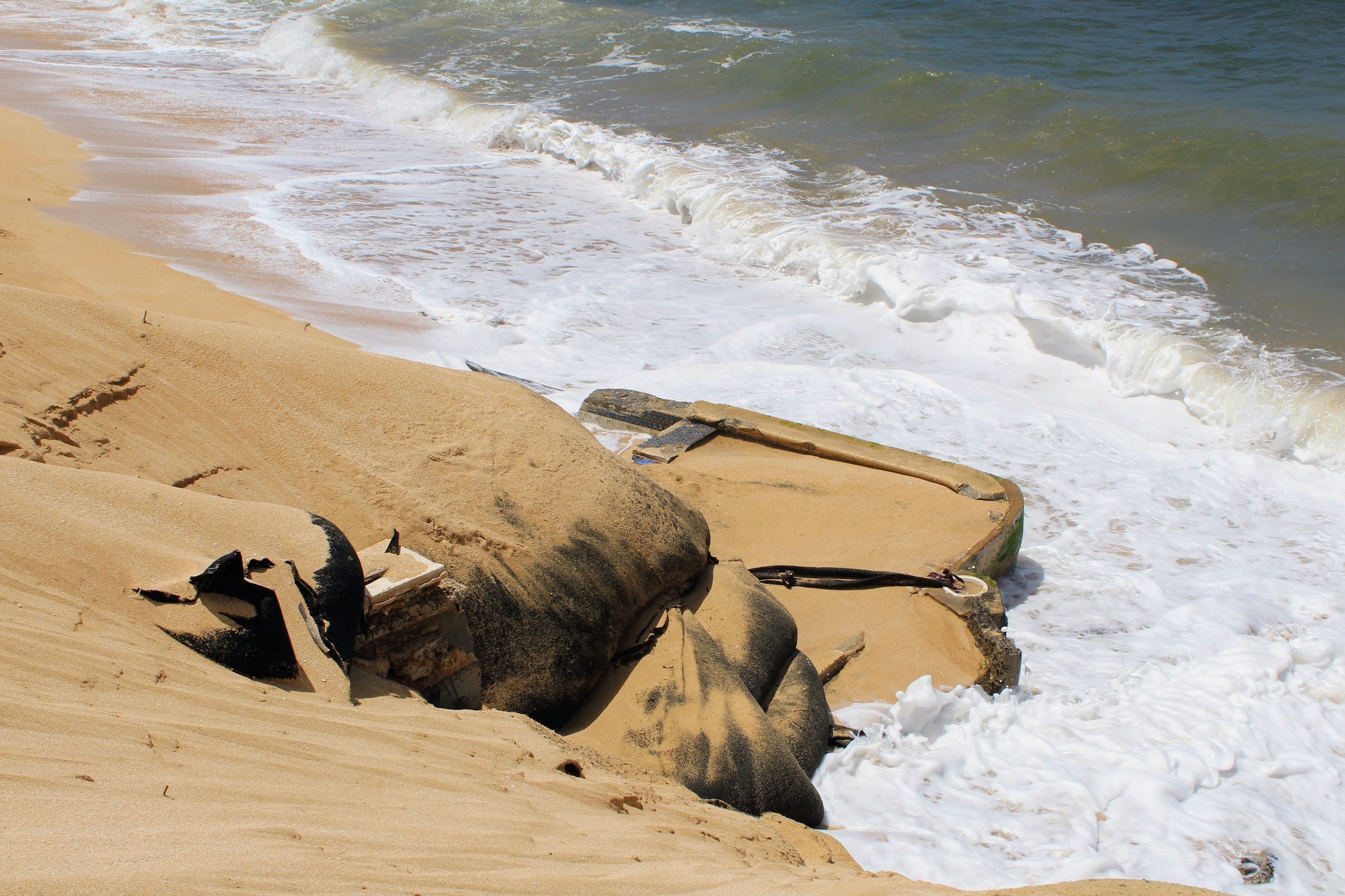
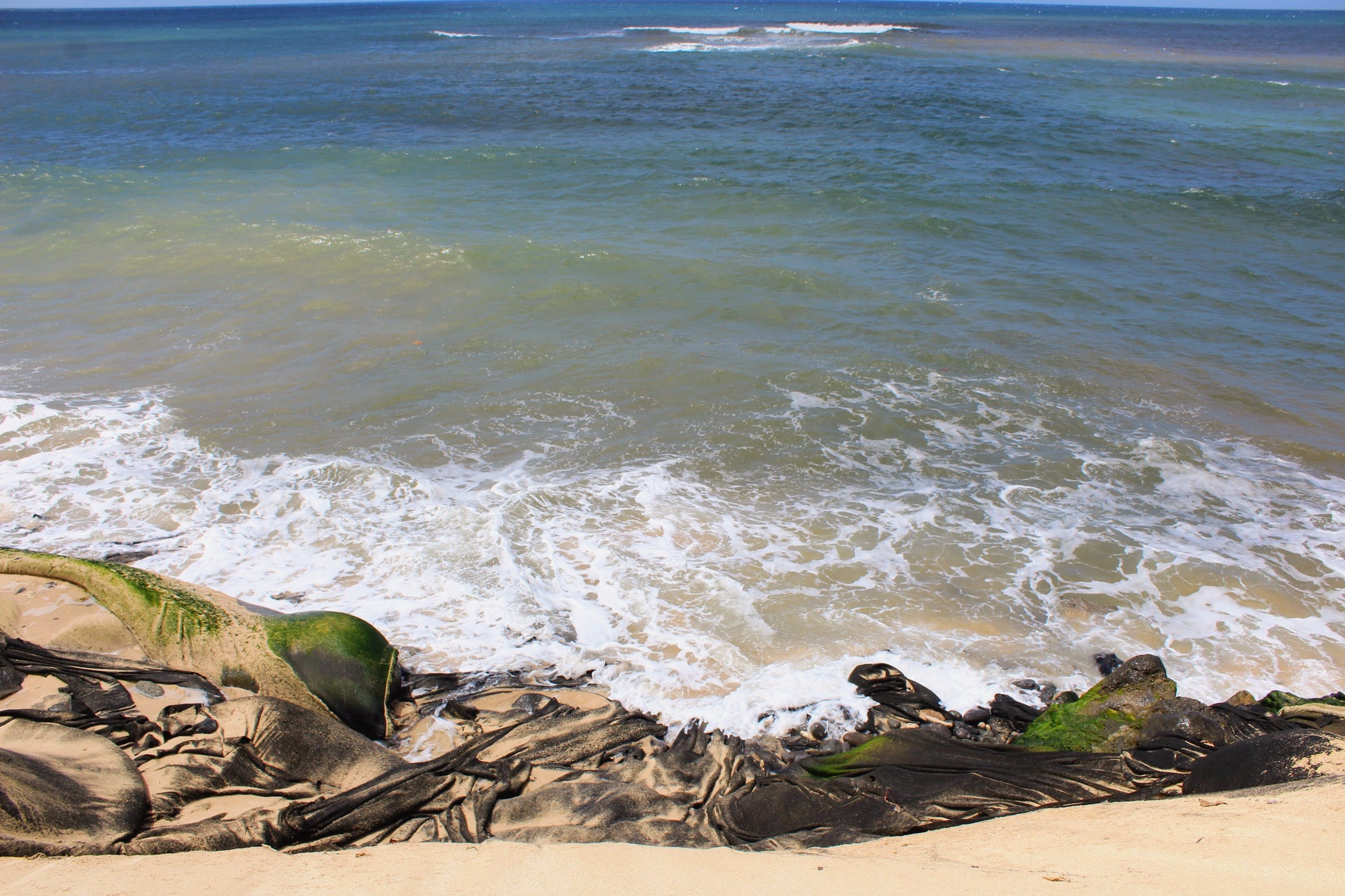
HONOLULU — Walking the stretch between Sunset Beach and Rocky Point on O’ahu’s North Shore today means choosing between a violent shoreline that could sweep you away, or climbing the top of giant geotextile tubes filled with sandbags called “sand burritos,” installed by property owners as temporary makeshift barriers to fight coastal erosion.
Standing on a sandbar separating the murky Pa’amalu stream from the sea, Denise Antolini and I paused to watch a pregnant woman and her husband precariously cross atop these massive “sand burritos” covered in black fabric. We waited for them to pass before we set off in the opposite direction. One misstep, and you might just fall down the steep embankment onto the shrinking strip of the shore below.
“It’s very, very dangerous to have this kind of lateral access,” said Antolini, a former resident of this coastline. “That’s the only access the public has right now, and it’s a big problem. We need to have this stuff removed and the beach restored, so we don’t have to walk treacherously like that.”
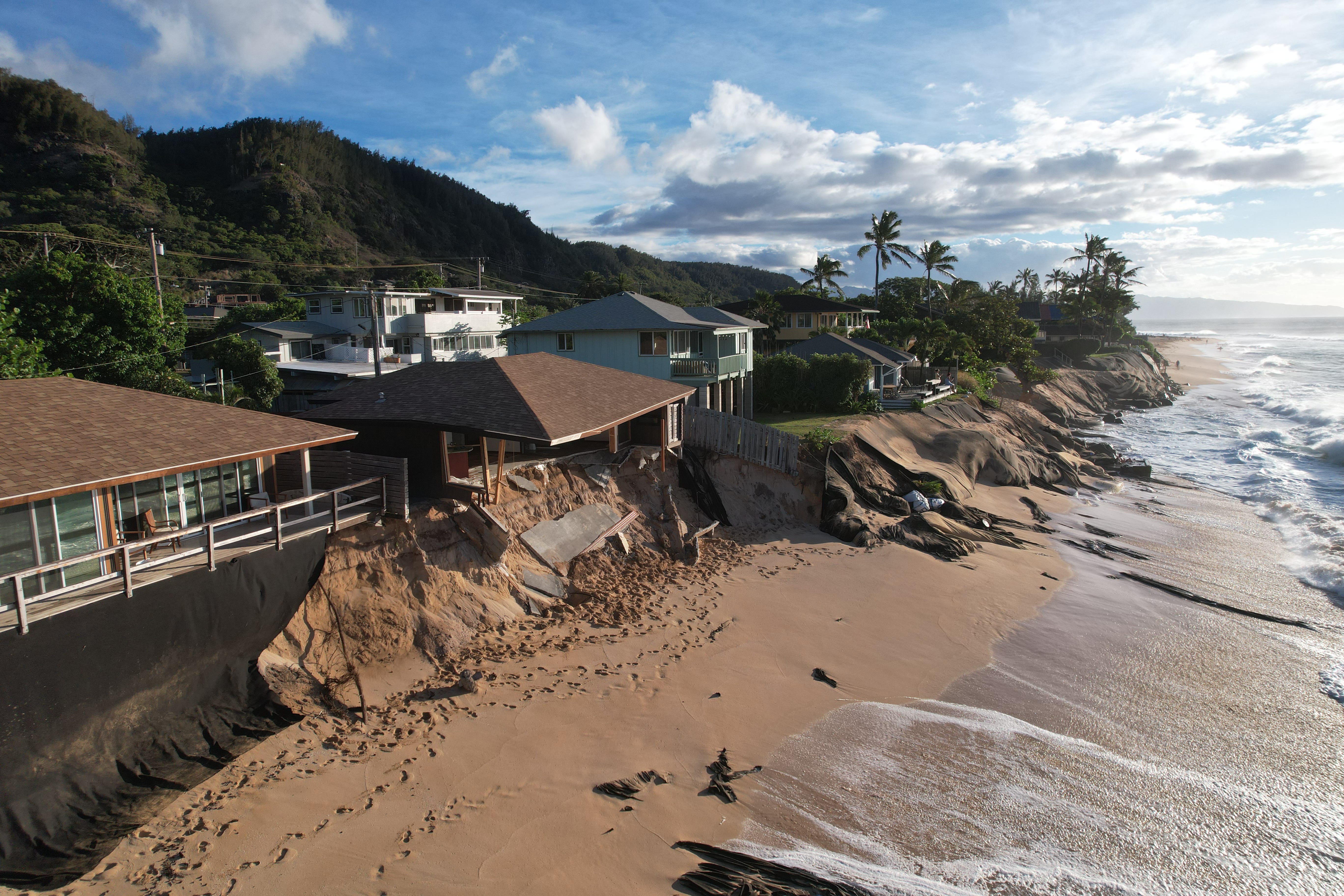
One by one, Antolini pointed out the multi-million-dollar oceanfront homes that had collapsed, been demolished, or moved back. Nearly three-quarters, or 73%, of North Shore beaches suffer from chronic erosion—a figure expected to reach nearly 90% within 30 years as sea levels rise to just 10 inches, according to 2020 data. Additionally, 28% of beachfront homes along this key 2.5-mile stretch currently sit within 20 feet of water. With about two feet of sea level rise, that number climbs to roughly 40%. Desperate to protect these investments, landowners have been pushing for temporary fixes like seawalls or “sand burritos” to delay the inevitable.
There was a time when the government “was handing out seawall permits like Halloween candy,” said Charles Fletcher, a climate scientist and the dean of the School of Ocean Earth Science and Technology at the University of Hawai’i at Mānoa. “They didn’t realize that in an era of rising sea level, if you trap the beach, it’s going to drown and go away.”
When sea levels rise, beaches naturally move inland to survive. If they have nowhere to move, they drown. Building seawalls or placing sandbags to protect coastal property blocks this natural movement. Instead of saving the beach, these hard barriers cause incoming waves to wash away the sand even faster, damaging nearby properties and eventually causing the beach to completely disappear.
In Hawai’i, all sandy beaches extending landward to the highest reaches of the waves belong to the public, and as rising seas erode the coast, that public boundary shifts inland into once-private land. To defend its shores, the state enacted a series of aggressive, first-of-their-kind laws: banning coastal armoring such as seawalls and “sand burritos” in 2020, mandating real estate sellers to disclose sea-level rise risks as well as the presence of illegal erosion barriers in 2021, and cracking down with heavy fines on long-expired and unpermitted coastal armoring like sandbags in 2023. Yet despite these stringent legal hurdles, wealthy owners keep pouring millions into crumbling oceanfront estates—igniting a fierce battle between private property rights and the survival of Hawai’i’s public beaches.
“We’re at a real crisis point,” warned Antolini, a retired law professor at the University of Hawai’i at Mānoa turned full-time environmentalist. “Somebody needs to speak for the beach.”
‘Unknowing buyer’
Before moving up the hill further inland in Pūpūkea, Antolini used to live just one house behind the oceanfront properties on the North Shore. The “Kammies,” as the locals call this part near Sunset Beach, was their family beach, she said. As we stood under a tree next to a now empty lot where a house recently collapsed, Antolini recalled a coconut tree nearby where her kids used to swing in. That tree is now gone.
“Trees just started to fall in,” she said. “These are all sentimental memories that are not all important in the scheme of things, but it was a sign that things were shifting.”
For years, Antolini documented nearly everything that went on at the beach as it shrunk, so she empathizes with long-time residents whose homes are threatened with erosion. But she said she doesn’t “have a lot of empathy for non-local owners,” who buy beachfront houses for vacation rentals and refuse to abide by the law.
“The large part of the problem is that a lot of the newer landowners don’t get it,” Antolini said. “They just have this romantic vision of the beach, and the real estate agents sell them this romantic vision. The problem is they screw up the beach for people who live here.”
Because private landowners have long exploited “hardship variance” loopholes to build shoreline hardening structures on public beaches to protect their property, nearly 30% of O’ahu’s sandy coastline now has seawalls.
“The historical response to coastal hazards and erosion has been to armor. That’s the past practice that we’re kind of stuck with now, because it’s really difficult to remove them,” says Dolan Eversole, a coastal geologist at the University of Hawai’i Sea Grant College Program and Waikīkī Beach Management Coordinator. “The problem with armoring is the accommodation space is reduced, if not eliminated. The sand source that would normally feed the beach through erosion is now locked up, so the bank savings account of sand is now lost.”
Models project that 81% of O’ahu’s coastline could experience erosion by the end of the century, with 40% of this loss happening by 2030. That warning stems from a 2017 state government report mapping Hawai’i’s coastal vulnerability, which concluded that climate change-fueled sea-level rise could cause $19 billion in property damage and displace 20,000 residents, potentially as early as 2060. The report, led by Fletcher and his team, introduced the Sea Level Rise Exposure Area, which is now the state’s official mapping tool for identifying land threatened by chronic flooding, high waves, and coastal erosion.
It’s also the basis for Hawai’i’s landmark law requiring real estate sellers to disclose to buyers if a property sits within a 3.2-foot projected sea level rise zone. While many states mandate disclosures for hazards like floods, tsunami, or fires, Hawai’i became the first to legally require disclosure of sea-level rise risks. It also requires sellers to disclose any shoreline protection structures like seawalls, rock barriers or temporary sandbags in the property that could affect a home’s value. If any of these are built without proper permits, and the seller fails to disclose them, they risk facing major lawsuits from the buyer.
“Good disclosure puts known risk squarely into the transaction,” said Jason Wong, an O’ahu-based principal real estate broker and founder of Island Dragonfly. “You can’t fight the Pacific Ocean with a few sacks of sand. When you buy an oceanfront property, you need to understand the risk you’re actually buying, including what protections may or may not be available in the future.”
By documenting these hazards upfront, the law eliminates the “unknowing buyer” excuse typically used to demand emergency seawall or sandbag exemptions, shifting long-term financial responsibility directly onto the owners. And between strict bans on shoreline hardening and tighter disclosure laws, oceanfront landowners face a rapidly narrowing window of legal remedies.
“It’s unfortunate and sad, and we want to do our best to provide carrots and sticks for this transition away from the shoreline for our communities,” said Colin Lee, an attorney and climate change policy analyst in the School of Ocean and Earth Science and Technology at the University of Hawai’i at Mānoa.
“But at the end of the day, this is something that was deeply understood in American and Hawaiian law from the outset—that you were always at risk of the changing ocean dynamic boundaries, and ultimately, he who enjoys the benefit bears the burden.”
So, who’s still buying?
On an early morning walk along Waikīkī Beach, Wong tells me most of his clients—many of whom are typically more affluent, international buyers who don’t mind taking on additional risk—actually appreciate the transparency of disclosure laws, even though potential hazards rarely derail the purchase.
“For a lot of out-of-state and international buyers, the reasons are more ordinary than people assume—family, a second home, sometimes a business reason underneath it,” he said. “A documented risk doesn’t usually end the conversation. It changes what they offer.”
Recent data support this buyer mindset. A study published in 2025 analyzed transactions from 2000 to 2022 before the full disclosure law was enforced and found that properties exposed to a projected 3-feet of sea level rise depreciate by 0.8% annually than unexposed properties. It also shows that local buyers are proving to be significantly more attuned to risks of rising seas than out-of-state investors.
Properties purchased by Hawai’i residents carry a 1.4% annual exposure penalty at just two feet of projected sea level rise, whereas non-local buyers penalize the exact same risk by only 0.7%. That means because out-of-state buyers are willing to pay closer to full market price for these vulnerable properties, they end up outbidding local residents who are factoring the long-term structural and insurance liabilities into their offers. In other words, local buyers demand a bigger discount for climate risks than non-local buyers do.
The disclosure law aims to address this gap. If non-local buyers are outbidding locals simply because they lack clear information about the hazards, mandating transparency should level the playing field, according to Makena Coffman, professor of urban and regional planning and director of the Institute of Sustainability and Resilience at the University of Hawai’i at Mānoa. But if out-of-state buyers already understand the hazards and are just more comfortable taking the gamble, the law won’t change their behavior.
“It’s very easy to kid yourself that the beach looks great right now, but do people know the risk, understand the laws, and are they willing to live by the rules?” Coffman added. “The reality is our beaches are part of the public trust. We have a rolling shoreline … and anything that stops the rolling shoreline is illegal. It doesn’t leave much room for interpretation.”
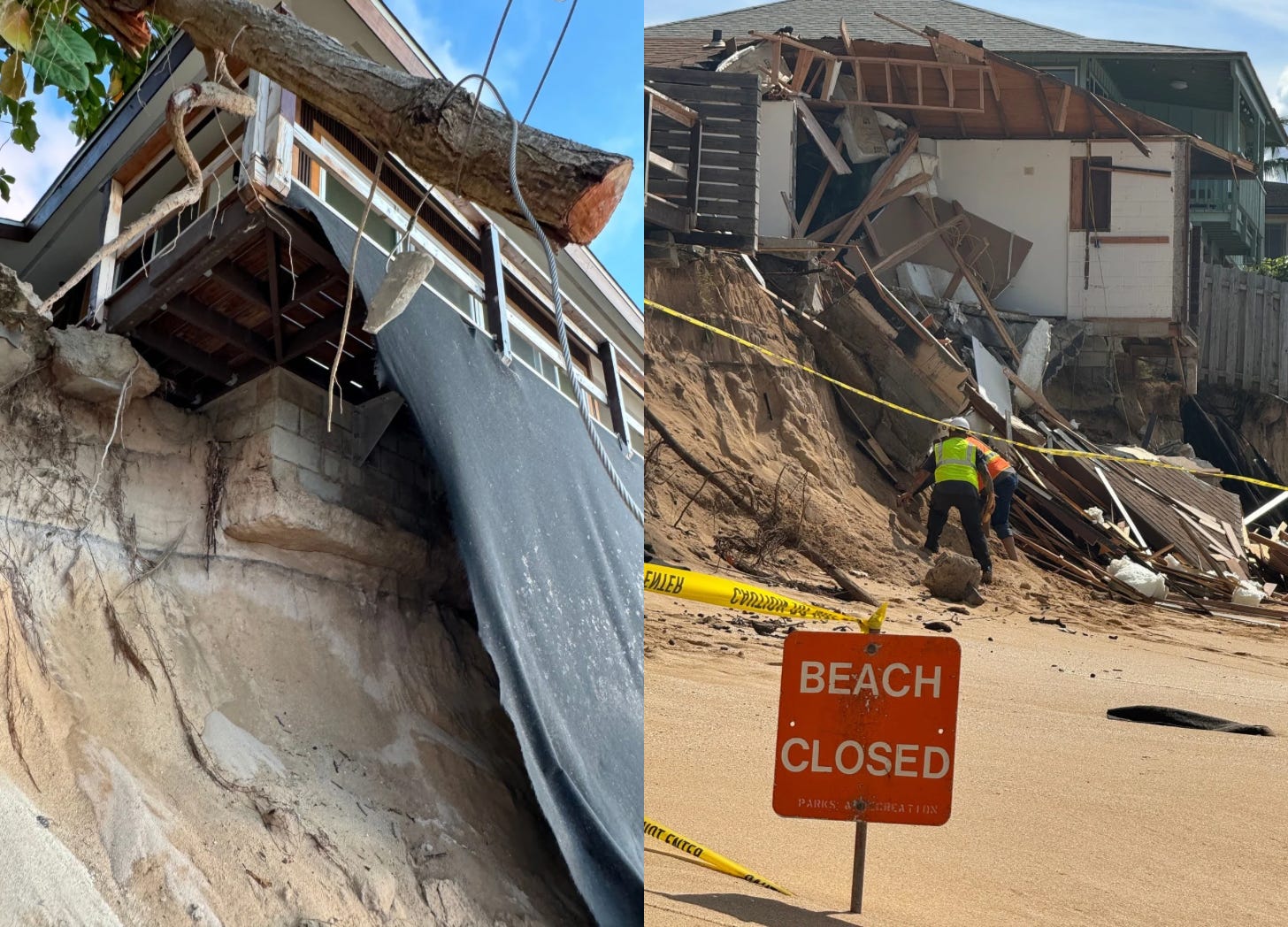
But along O’ahu’s North Shore, it’s a different story. At the eastern end of Ke Nui Road, two vacant lots owned by the same individual now sit where homes once stood—one protected by sandbags that fell into the ocean, and another that was demolished at the request of the government. Tattered black fabric from unauthorized “sand burritos” still litters the beach while legal fights delay cleanup. Yet despite the severe erosion, the lots remain listed on Zillow for $150,000, advertised with the caveat that the land can no longer be used for housing.
The ongoing tension along the coastlines reflects a fundamental clash between short-term financial interests and multi-generational financial responsibility, said Hanna Lilley, the Hawai’i regional manager for the Surfrider Foundation, a non-profit environmental group that played a pivotal role in passing the real estate disclosure law. Instead of recognizing their role as temporary caretakers of the shoreline, many private property owners prioritize gain over long-term preservation, she added.
“[Landowners] are looking at their investment and what they can get out of it,” Lilley said. “Many of them aren’t really embracing that they have a huge responsibility being on the shoreline—that they are like a servant of the shoreline in a sense, and that there’s a strong responsibility to maintain this public resource.”
Although passing the real estate disclosure law is a win, advocates like Lilley argue it still falls short. Under current law, disclosures are only triggered after a buyer has made a commitment and an offer has been accepted.
“What we’re pushing for now is for all of this to be disclosed in the advertisement [of the property],” she said. “So upfront, when buyers are looking through listings, instead of seeing a beautiful oceanfront property where you can hear the waves crashing at night, they know they also get all of these risks.”
Although the bill requiring disclosure in advertisement failed in the last legislative session, shoreline advocates plan to keep reintroducing it. “It’s the truth in advertising,” Lilley said. “It protects the consumer; it’s very central to a property’s value, and it’s just key to protecting Hawai’i’s beaches.”
Sink or shift
Without stronger enforcement and long-term strategies, planet-warming pollution will turn Hawai’i’s occasional flooding into a regular, dangerous reality, climate scientist Fletcher said.
“In the mid 2030’s, we’re going to really see the chickens come home to roost on this issue,” he said. “Our king tides are going to go from happening 20 days a year to 120 days per year, and they’re going to be higher. Our models show that Hawai’i is also going to see 15 to 20% [of sea level rise] more than the global average.”
Coastal planners and lawmakers are increasingly forced to consider a controversial and once-unthinkable solution: managed retreat—the planned, strategic relocation of people, homes, and infrastructure away from high-risk areas, particularly encroaching seas.
But “moving that many people and that much infrastructure ahead of the water is enormously difficult and expensive,” Lee said. “And the political will to do it before the damage is simply not there.”
For rural beachfront communities, like O’ahu’s North Shore, moving infrastructure is increasingly seen as the only realistic long-term outcome. While most property owners refuse to give up their investments that easily, some have expressed interest in a voluntary buyout.
“If we got rid of the houses and the ocean could take that sand, then it would feed the beach as the shoreline migrates landwards,” Fletcher said. “That sand is the lifeblood of the beach, and the beach need not be damaged by sea level rise if it had free and unfettered access to migrate landward.”
“The question is, where is that money going to come from? That’s the giant unknown,” he added.
In 2022, the neighboring island of Maui established a first-of-its-kind managed retreat fund powered by a 20% cut of the county’s tourism tax, designed to generate millions to dismantle eroding structures and shift roads inland. But when the devastating 2023 Lahaina wildfires struck, the county froze new deposits to divert urgent funds toward workforce housing for displaced locals, highlighting how immediate crises can easily derail long-term adaptation planning.
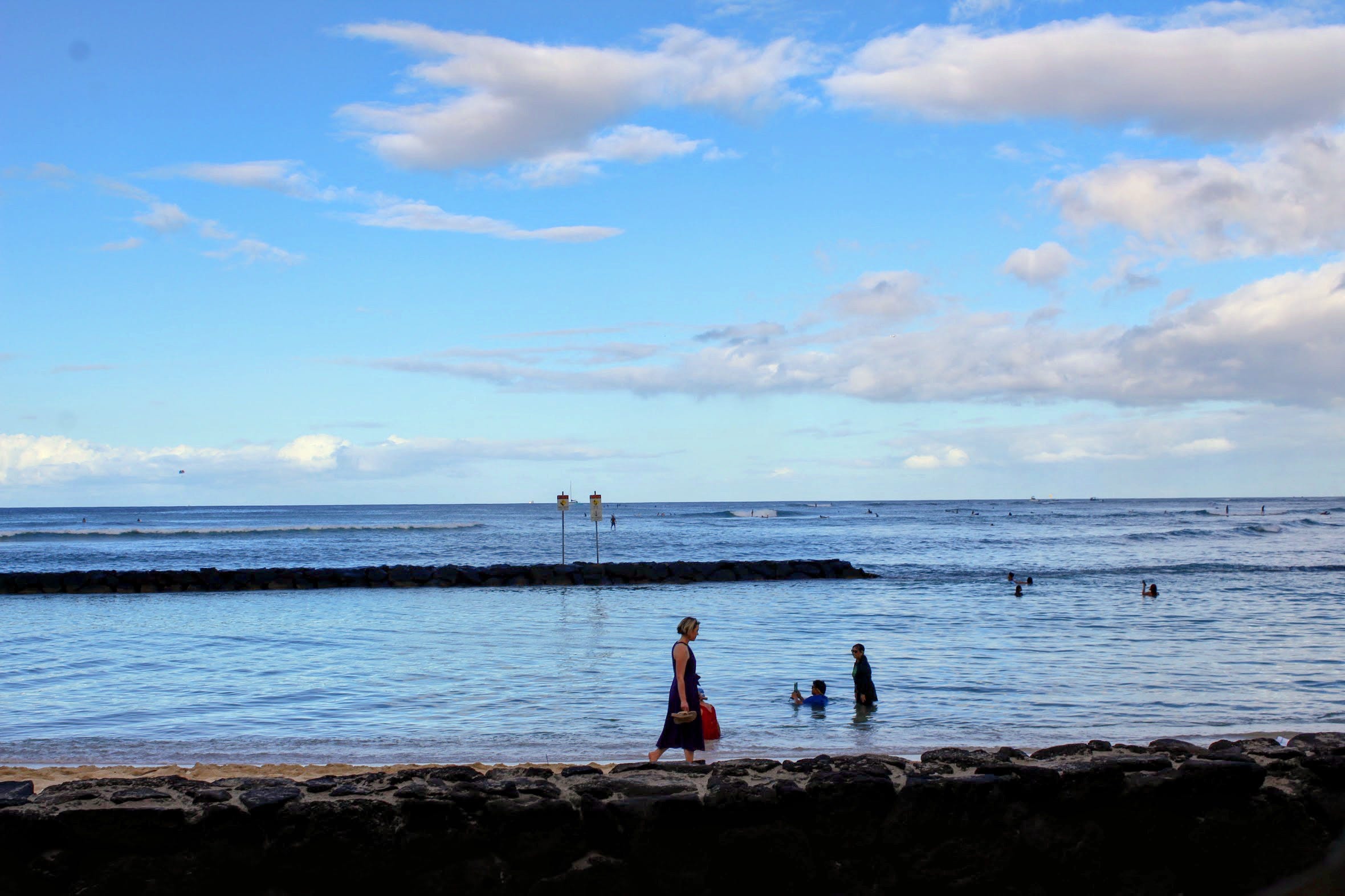
In places like the multi-billion-dollar tourism hub of Waikīkī, retreat is not an option due to its economic importance. Ever since it was carved out of a wetland in the 1920s, Waikīkī has relied on seawalls, groins, and imported sand to survive. Now, commercial landowners there pay an extra tax—generating roughly $600,000 to $1 million annually—to continuously pump sand and hold back the sea, securing protection that rural residents can only dream of.
Private property owners in rural areas push to do the same thing, but “[beach] nourishment needs a sand source and recurring money, and neither one scales to every eroding shoreline in the state,” Lee said.
Scaling these solutions has faced public backlash. In a state trapped in a generational housing crisis, spending public dollars to buy out wealthy oceanfront landowners looks to many like a bailout for private risk.
This friction unfolds alongside a steady local exodus. Many locals are moving out of Hawai’i in steady numbers, with more residents moving to other states than new arrivals to the islands over the last two decades. Driven by stagnant wage growth and limited economic opportunities, more Native Hawaiians now live in the other 49 states than in Hawai’i itself. This shift has profound implications when it comes to ancestral connections and cultural heritage.
Still, Hawai’i remains a living proof-of-concept of turning climate science into real-world policy. Securing capital for research is one hurdle, but translating those funds into action requires policy that responds to the local realities of the shore.
“Each section of the beach is its own story,” Antolini said. “We need really strong guardrails and direction, but you also need solutions that are going to be very local. Then, we need to get the heck off the shoreline.”
This story is part of Betting the House, a pop-up climate newsroom composed of independent journalists—each exploring, though their own lens, why people keep buying, selling, and protecting homes in climate-threatened areas. The project spans Florida, Louisiana, Hawaiʻi, North Carolina, and Connecticut. Read and watch the rest of the series below.
The open houses at the edge of disaster: What are buyers being told about climate risk in Miami? I posed as one to find out. By Emily Atkin of HEATED.
Houses Built on Sand: Why coastal homeowners in North Carolina and Connecticut are spending big on small moves. By Ben Tracy of Climate Central.
Too Attached to Leave: In New Orleans, who decides which communities we protect? And who gets left behind? By Chase Cain of Chase What Matters.