


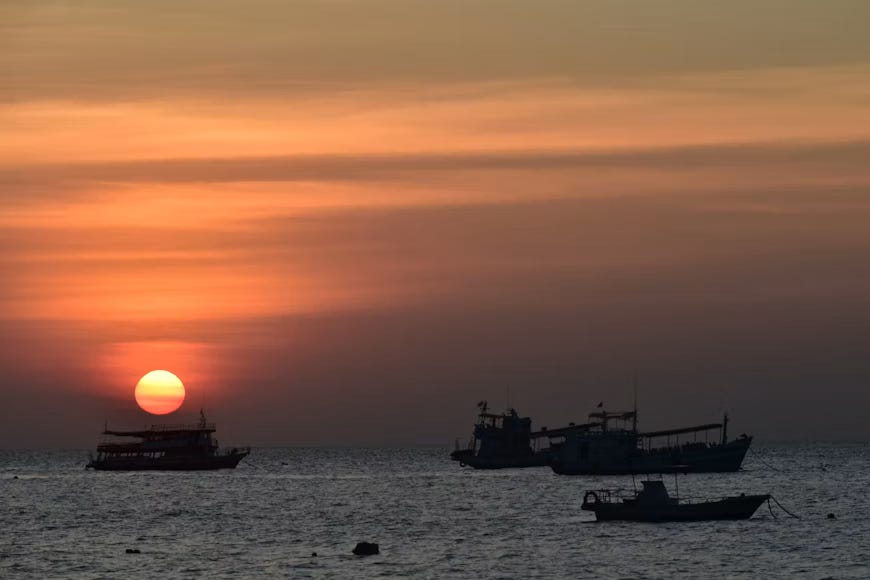
At the crack of dawn one June day in 2011, 32 Indonesian crew members of the fishing vessel Oyang 75 escaped into the port of Lyttelton, New Zealand. They were fleeing extreme labor abuses that ranged from debt bondage and wage theft to grueling work hours.
The ship they left behind was a Korean factory trawler, chartered by a New Zealand company to fish domestic waters. For decades, New Zealand fishing companies have relied on this exact arrangement: chartering foreign-owned and flagged deep-sea trawlers, largely from South Korea, to access lucrative offshore quotas at low operational costs.
But New Zealand’s industry is far from an isolated case. A recent paper published in the journal Marine Policy paints a damning picture of how the global seafood industry has developed a widespread system built on modern slavery, severe human rights violations, and environmental fraud.
The issue “should not be treated as a series of isolated scandals or a few bad actors at sea,” Abdirahim Sheik Heile, one of the paper's authors and a doctoral candidate in marine studies at Dalhousie University, told The Confluence. Instead, Sheik Heile argues that labor exploitation is a "structural feature of the global seafood economy."
That exploitation is only worsening under current economic pressures. With global grocery prices inflating at an alarming rate, the mounting pressure to keep seafood cheap is creating even stronger incentives to slash labor costs. According to Sheik Heile, who is also a fellow with Ocean Nexus, that cost-cutting directly manifests as wage theft, unsafe working conditions, excessive hours, debt bondage, and the denial of basic rights.
“When we talk about sustainable seafood, we cannot only ask whether the fish stock is healthy,” Sheik Heile said. “We also have to ask, who caught the fish, under what conditions, and who benefits from the value created?”
The paper also found a strong connection between workforce exploitation and illegal fishing, noting that the same governance gaps, vague vessel operations, and economic pressures fuel both crises simultaneously.
But unraveling this systemic crisis has proven difficult due to how these fleets operate. Daniel Salas, the paper’s lead author and a doctoral candidate of social anthropology at Dalhousie University, said “exploitation in fisheries operates through transnational systems fragmented by design.”
It’s almost a regulatory black hole, in which the process is split across so many nations that accountability completely vanishes: “Workers from one country may be recruited through brokers in another, labor on vessels flagged to a third country, fish in the waters of a fourth country, while the seafood itself enters supply chains somewhere else,” Salas told The Confluence. “That fragmentation is one reason exploitation becomes so difficult to monitor and regulate.”
The research began after the team realized that while a substantial body of work on labor exploitation and human rights abuses in fisheries already exists, it remains scattered across completely different disciplines and journals. By stepping back to review more than 50 studies based on primary data, the authors uncovered just how normalized and systemic labor exploitation has become in the global seafood industry.
“One thing that became very clear was just how invisible fish workers often are, even within governance systems supposedly designed to protect them,” Salas said. The most severe abuses, the study notes, appear repeatedly within industrial and distant-water fleets, particularly those relying heavily on migrant labor.
The authors also identified what they call an “uneven geography of scrutiny” in existing research. While much of the literature is heavily concentrated in Southeast and East Asia, vast stretches of the Atlantic, Africa, the Americas, and other major fishing nations remain deeply understudied.
“That doesn’t mean exploitation is absent in those places,” Sheik Heile said. “It means our knowledge is incomplete.”
That data gap is exactly why the 2011 New Zealand incident served as such a critical case study. “The documented abuses there shocked many observers precisely because the country was not imagined as a major site of labor exploitation,” Salas explained.
Today, these systemic vulnerabilities are colliding with a worsening climate crisis. Record temperatures are triggering a dramatic shift in fish migration patterns, making fish harder to find and forcing vessels to travel further and stay at sea longer. Because these extended voyages burn far more fuel, fleets are facing a brutal economic squeeze — one that Sheik Heile warns directly exacerbates labor exploitation in a fiercely competitive market.
“This is why climate change and ocean warming are also labor issues,” he said. “Ecological stress can intensify economic stress, and economic stress can intensify labor exploitation.”
Read more: A Fleet Prone to Captive Labor and Plunder, The Outlaw Ocean Project
To prevent even more abuse, researchers argue that climate adaptation plans and fisheries management must look beyond fish stocks to protect the people harvesting them. Effective reform, according to the study, requires a comprehensive overhaul: decent work protections, fair wages, secure contracts, and confidential worker reporting systems. It also demands targeted port inspections that assess labor conditions and overall accountability across the seafood value chain. For small-scale fishers, it means legally protecting their access rights, local markets, and coastal livelihoods from unfair competition by massive industrial fleets.
Rising inflation is already forcing shoppers to rethink their seafood spending. But researchers say it should also force a deeper reconsideration of the global supply chain.
Sheik Heile said his message is simple: “Loving seafood should also mean caring about the people who catch it,” urging consumers to ask harder questions about labor conditions.
As economic pressures tighten across the globe, the authors maintain that true sustainability can no longer be measured purely by grocery store price tags or healthy fish stocks.
“Seafood sustainability cannot only be about fish; it must also be about human dignity,” Sheik Heile said. “A fish cannot be called sustainable if it reaches the plate through exploitation. If we want healthy oceans, we need to protect the people who work at sea.”

In other news ….
Trump goes after ocean monitoring. The Trump administration is dismantling a $368 million deep-sea monitoring system that was put in place a decade ago to examine coastal environments, marine ecosystems and powerful currents that affect the global climate. The National Science Foundation, which has been stripped off federal funding, said it would send ships this month to remove over 900 deep-sea instruments anchored off Oregon, Washington, Alaska, North Carolina, and an area between Greenland and Iceland known as the Irminger Sea. The New York Times reports.
Aotearoa marine sanctuaries. New Zealand just established five new marine reserves along the Otago coast, marking the country’s first new marine sanctuaries in over a decade. Oceanographic Magazine reports.
More El Niño woes. The expected arrival of El Niño in the coming months could trigger another mass coral bleaching event, just a year after the last one ended, the National Oceanic and Atmospheric Administration warned this week. If it happens, this would mark the fifth global mass bleaching incident in recorded history. CBS reports.